Forgive and Forget Bible Verse: What Scripture Says

Maybe you’re here because someone hurt you deeply, and now the phrase “forgive and forget” feels heavy instead of helpful. You want to honor God, but you also wonder whether real forgiveness means pretending it didn’t happen, ignoring the ache, or letting someone hurt you again. You are not failing if your heart still remembers.
On this page, you’ll find what Scripture actually says about forgiving, remembering, healing, and wise boundaries - gently organized for the real questions that come after hurt. For tender, honest healing, let’s begin with the question many people are really asking.
Quick answer
Best Bible verses about forgiving and forgetting
Best overall
“Be kind and compassionate to one another, forgiving each other, just as in Christ God forgave you.”
When hurt lingers
“It does not dishonor others, it is not self-seeking, it is not easily angered, it keeps no record of wrongs.”
Leaving justice to God
“Do not take revenge, my dear friends, but leave room for God's wrath, for it is written: 'It is mine to avenge; I will repay,' says the Lord.”
When bitterness grows
“See to it that no one falls short of the grace of God and that no bitter root grows up to cause trouble and defile many.”
Wise boundaries
“The prudent see danger and take refuge, but the simple keep going and pay the penalty.”
God remembers no more
“For I will forgive their wickedness and will remember their sins no more.”
On this page
- Is there a “forgive and forget” Bible verse?
- The key verses people mean when they say “forgive and forget”
- What does the Bible mean by forgiveness?
- Does God “forget” sins?
- You can forgive and still remember what happened
- Forgiveness does not mean removing all boundaries
- How to forgive when the pain still feels fresh
- Verses for specific situations of hurt
- A short prayer for forgiving and letting God carry the memory
- How Faithjar helps when forgiveness feels impossible right now
Is there a “forgive and forget” Bible verse?
If you have searched for a “forgive and forget” Bible verse, you are not alone. Many women come looking for one simple line that can steady the heart after betrayal, conflict, or words they cannot seem to stop replaying.
State clearly that the exact phrase is not found in Scripture
The clearest answer is this: the exact phrase “forgive and forget” does not appear in the Bible. Scripture absolutely speaks about forgiveness, mercy, and releasing wrongs, but it does not give that familiar saying as a direct verse.
That matters, because sometimes the phrase can sound heavier than what God is actually asking of you. He is not asking you to pretend pain never happened or to force your mind to erase a wound overnight.
Explain why readers often connect the idea to forgiveness passages
People usually connect this phrase to several well-loved passages that speak about forgiving others, not keeping a ledger of offenses, and leaving the past in God’s hands. Those verses are real, beautiful, and important - they simply do not say the exact wording many of us grew up hearing.
“For if you forgive other people when they sin against you, your heavenly Father will also forgive you.” - Matthew 6:14 (NIV)
“Be kind and compassionate to one another, forgiving each other, just as in Christ God forgave you.” - Ephesians 4:32 (NIV)
“It does not dishonor others, it is not self-seeking, it is not easily angered, it keeps no record of wrongs.” - 1 Corinthians 13:5 (NIV)
These are often the verses people mean. They are why “forgive and forget” feels biblical, even though the phrase itself is not found in Scripture.
Give the short answer up front: the Bible commands forgiveness, not mental amnesia
Here is the short answer up front: the Bible commands forgiveness, but it does not command mental amnesia. Biblical forgiveness means releasing personal vengeance and refusing to hold the offense over someone forever; it does not mean your human memory suddenly goes blank.
“Do not take revenge, my dear friends, but leave room for God’s wrath, for it is written: ‘It is mine to avenge; I will repay,’ says the Lord.” - Romans 12:19 (NIV)
“Brothers and sisters, I do not consider myself yet to have taken hold of it. But one thing I do: Forgetting what is behind and straining toward what is ahead,” - Philippians 3:13 (NIV)
So if you still remember what happened, that alone does not mean you have failed. It means you are human - and God’s Word will gently help you understand what forgiveness really looks like.
The key verses people mean when they say “forgive and forget”
When people use the phrase “forgive and forget,” they are usually reaching for a handful of Scriptures about mercy, released resentment, and moving forward with God. These verses do not ask you to pretend nothing happened, but they do show what a forgiving heart looks like in real life.
Matthew 6:14–15 on forgiving others
Jesus speaks very plainly here, which is why this passage is so often connected to the phrase. The emphasis is not on erasing memory, but on the serious, daily practice of forgiving others before bitterness hardens around the wound.
“And when you stand praying, if you hold anything against anyone, forgive them, so that your Father in heaven may forgive you your sins.” - Mark 11:25 (NIV)
“Forgive, and you will be forgiven.” - Luke 6:37 (NIV)
These verses echo the same call as Matthew 6:14–15: forgiveness matters deeply to God, and it belongs in ordinary moments of prayer, conflict, and healing.
Ephesians 4:32 on forgiving as Christ forgave
This is one of the clearest summaries of Christian forgiveness. It roots mercy in the way Christ has treated us, which means forgiveness is not pretending the hurt was small; it is choosing grace because God has shown grace to us first.
“Be kind and compassionate to one another, forgiving each other, just as in Christ God forgave you.” - Ephesians 4:32 (NIV)
“Bear with each other and forgive one another if any of you has a grievance against someone. Forgive as the Lord forgave you.” - Colossians 3:13 (NIV)
If you are sorting through anger as well as forgiveness, our guide to scriptures about letting go of anger may help you bring both honestly before God.
1 Corinthians 13:5 on keeping no record of wrongs
This verse is often the closest biblical match to what people mean by “forget.” Love does not keep a running ledger to bring out later as a weapon. That does not mean you lose memory; it means you stop using the memory to keep the other person forever on trial.
“It does not dishonor others, it is not self-seeking, it is not easily angered, it keeps no record of wrongs.” - 1 Corinthians 13:5 (NIV)
“Above all, love each other deeply, because love covers over a multitude of sins.” - 1 Peter 4:8 (NIV)
Philippians 3:13 on leaving what is behind
People also connect “forget” with Paul’s language about leaving the past behind. In context, this is about pressing forward in Christ. It can gently encourage you not to stay chained to yesterday, even while healing still takes time.
“Brothers and sisters, I do not consider myself yet to have taken hold of it. But one thing I do: Forgetting what is behind and straining toward what is ahead.” - Philippians 3:13 (NIV)
“Do not repay anyone evil for evil. Be careful to do what is right in the eyes of everyone. If it is possible, as far as it depends on you, live at peace with everyone.” - Romans 12:17–18 (NIV)
Moving forward is not denial. It is a grace-filled way of saying the hurt will not be allowed to write the whole story.
What does the Bible mean by forgiveness?
When someone has wounded you, forgiveness can sound simple in a sentence and impossibly heavy in real life. In Scripture, forgiveness is not pretending the hurt was small - it is a grace-filled response that releases your heart from carrying revenge, bitterness, and the need to keep striking back.
Forgiveness as a decision to release personal vengeance
Biblical forgiveness begins as a choice to hand justice over to God instead of making retaliation your mission. That does not mean calling evil good; it means refusing to let revenge become the thing that shapes your next step.
“Do not be overcome by evil, but overcome evil with good.” - Romans 12:21 (NIV)
“My command is this: Love each other as I have loved you.” - John 15:12 (NIV)
Forgiveness as refusing to weaponize past wrongs
Forgiveness also means you stop turning an old wound into a weapon for new moments. Love does not keep collecting evidence for the next argument; it chooses not to continually count, replay, and use the offense to punish.
“Love is patient, love is kind. It does not envy, it does not boast, it is not proud… it keeps no record of wrongs.” - 1 Corinthians 13:4-5 (NIV)
“Get rid of all bitterness, rage and anger, brawling and slander, along with every form of malice.” - Ephesians 4:31 (NIV)
If anger is still loud in your chest, these Bible verses about anger can help you bring that fire gently before God.
Forgiveness as flowing from God’s mercy toward us
The Bible never presents forgiveness as something we squeeze out by sheer willpower alone. We forgive from a place of having first received mercy ourselves - undeserved, tender, and complete in Christ.
“If we confess our sins, he is faithful and just and will forgive us our sins and purify us from all unrighteousness.” - 1 John 1:9 (NIV)
“In him we have redemption through his blood, the forgiveness of sins, in accordance with the riches of God’s grace.” - Ephesians 1:7 (NIV)
Difference between forgiveness, reconciliation, and restored trust
These are not all the same thing. Forgiveness can be offered from your heart before God; reconciliation involves relationship and repentance; restored trust usually takes time, fruit, and safety. Scripture makes room for both mercy and wisdom.
“So watch yourselves. If your brother or sister sins against you, rebuke them; and if they repent, forgive them.” - Luke 17:3 (NIV)
“The prudent see danger and take refuge, but the simple keep going and pay the penalty.” - Proverbs 22:3 (NIV)
That distinction matters deeply, especially for women carrying family hurt, betrayal, or repeated harm: a forgiving heart does not require unsafe closeness or instant trust.
Does God “forget” sins?
When readers hear that God “forgets” sin, it can sound almost too simple for the weight of real failure. Scripture gives a deeper, gentler picture: not divine neglect, but divine mercy that no longer holds confessed sin against His people.
Hebrews 8:12 and Jeremiah 31:34 on remembering sins no more
These verses are the heart of the phrase many Christians have in mind. God’s promise is not careless memory loss, but a covenant promise of full forgiveness.
“For I will forgive their wickedness and will remember their sins no more.” - Hebrews 8:12 (NIV)
“For I will forgive their wickedness and will remember their sins no more.” - Jeremiah 31:34 (NIV)
What comfort this brings: the Lord is not keeping a secret file of forgiven sin to reopen later. In His mercy, He chooses not to bring it forward for condemnation.
Isaiah 43:25 and Micah 7:19 on removing transgressions
Scripture also describes forgiveness with beautiful images of removal. God does not just say He is merciful; He paints mercy in ways a hurting heart can hold onto.
“I, even I, am he who blots out your transgressions, for my own sake, and remembers your sins no more.” - Isaiah 43:25 (NIV)
“You will again have compassion on us; you will tread our sins underfoot and hurl all our iniquities into the depths of the sea.” - Micah 7:19 (NIV)
These pictures are tender and strong at once: blotted out, cast away, no longer standing between God and His children.
Clarify covenantal language: God does not hold forgiven sin against His people
This is the key meaning. When God says He remembers sin no more, He means He no longer counts it against those He has forgiven. That is why forgiveness in Scripture is often described in terms of not counting sin.
“Blessed are those whose transgressions are forgiven, whose sins are covered. Blessed is the one whose sin the Lord will never count against them.” - Psalm 32:1-2 (NIV)
“God was reconciling the world to himself in Christ, not counting people’s sins against them.” - 2 Corinthians 5:19 (NIV)
If you are carrying shame, this matters deeply: forgiven sin is not being held over your head by God.
Why this does not mean literal loss of knowledge
God does not become less knowing. He is still the all-seeing Lord, and Scripture never suggests that He stops being God in order to forgive.
So when we say God “forgets,” we mean He mercifully chooses not to treat His people according to forgiven sin. That keeps this truth both comforting and steady: His forgiveness is deliberate, not forgetful.
You can forgive and still remember what happened
Many women carry a wound in their memory long after they have sincerely asked God to help them forgive. Scripture makes room for that reality: remembering is not the same thing as revenge, and healing is often gentler than we expected.
Why human memory does not cancel real forgiveness
Human hearts are not machines, and human minds do not simply delete pain on command. Biblical forgiveness is not pretending the hurt never happened; it is choosing not to hold the offense as a weapon in your hands.
“As far as the east is from the west, so far has he removed our transgressions from us.” - Psalm 103:12 (NIV)
God’s mercy shows us the pattern: removal of guilt, not denial of reality. If you still remember what was said, what was broken, or how trust was damaged, that alone does not mean you have failed to forgive.
How remembered pain can resurface without meaning you failed
Sometimes a memory comes back at bedtime, during a family gathering, or in the quiet after an argument. That resurfacing can feel discouraging, but it does not automatically mean your forgiveness was fake - it may simply mean the wound still needs the Lord’s care.
“He heals the brokenhearted and binds up their wounds.” - Psalm 147:3 (NIV)
“Cast all your anxiety on him because he cares for you.” - 1 Peter 5:7 (NIV)
When pain rises again, you do not need to panic or shame yourself. You can bring the memory back to Jesus again, asking Him to hold what still aches.
What it looks like to remember without bitterness
Remembering without bitterness means you stop feeding the injury with replayed arguments, silent revenge, or a private ledger of what the other person owes you. You may still name the wrong clearly, but you refuse to let it poison your spirit.
“See to it that no one falls short of the grace of God and that no bitter root grows up to cause trouble and defile many.” - Hebrews 12:15 (NIV)
“My dear brothers and sisters, take note of this: Everyone should be quick to listen, slow to speak and slow to become angry, because human anger does not produce the righteousness that God desires.” - James 1:19–20 (NIV)
If anger is still close to the surface, our guide to bible verses about anger may help you sit with God in that honest place.
Use comforting language for women carrying betrayal, grief, or family hurt
If you were betrayed by someone close, worn down by family conflict, or left carrying grief no one else can see, please hear this gently: a tender heart can forgive and still need time. The Lord is not asking you to become numb. He is inviting you to keep bringing your whole hurt into His care.
“There is now no condemnation for those who are in Christ Jesus.” - Romans 8:1 (NIV)
You are not disqualified from grace because the memory still stings. In Christ, you can be honest about what happened, receive comfort for today, and let healing come one surrendered moment at a time.
Forgiveness does not mean removing all boundaries
Many women carry this quiet fear: if I forgive, do I have to open the door wide again? Scripture makes room for both a soft heart and wise limits, especially when trust has been broken.
Trust may need to rebuild slowly
Forgiveness can be offered before trust is restored. Trust grows where there is repentance, honesty, and changed behavior over time - not simply because someone says the right words.
“If your brother or sister sins against you, rebuke them; and if they repent, forgive them.” - Luke 17:3 (NIV)
“Produce fruit in keeping with repentance.” - Luke 3:8 (NIV)
The Bible leaves space for observing fruit. You are not faithless for needing time; you are being truthful about what healing and trust actually require.
Safety matters in cases of abuse, manipulation, or repeated harm
If someone is harming you, forgiveness does not mean staying exposed to danger. The Lord never asks you to confuse mercy with remaining unprotected in an unsafe situation.
“I am sending you out like sheep among wolves. Therefore be as shrewd as snakes and as innocent as doves.” - Matthew 10:16 (NIV)
“The prudent see danger and take refuge, but the simple keep going and pay the penalty.” - Proverbs 22:3 (NIV)
If this is the kind of pain you are carrying, please choose safety, support, and wise help. Forgiveness can begin in your heart even while distance, protection, and accountability remain firmly in place.
Sometimes scripture meets us best in the exact moment your guard is tired and your heart is unsure.
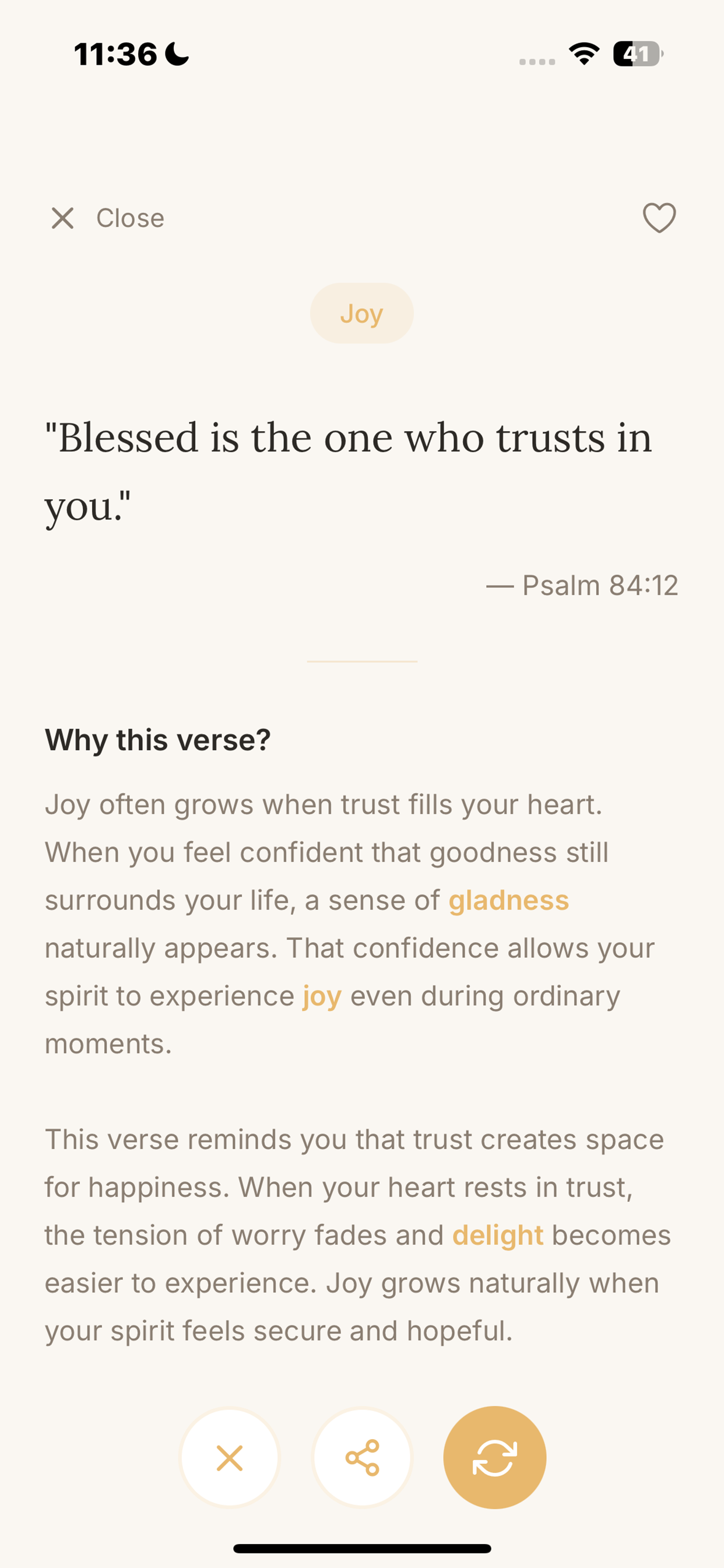
Open Faith Jar - free on the App Store
Tap what you feel right now - betrayed, afraid, angry, or exhausted - and receive a verse without having to search through the noise.
Wise caution is biblical, not unspiritual
Some believers feel guilty for being careful after they have been hurt. But biblical love is not gullible; it can be sincere, prayerful, and still attentive to reality.
“Do not be misled: ‘Bad company corrupts good character.’” - 1 Corinthians 15:33 (NIV)
“Above all else, guard your heart, for everything you do flows from it.” - Proverbs 4:23 (NIV)
Wise caution is not bitterness. It is stewardship of the heart God is healing.
Forgiving someone does not require pretending nothing happened
Forgiveness tells the truth. It does not rewrite the story, erase consequences, or demand instant restoration of a relationship or role.
“Then David said to Nathan, ‘I have sinned against the Lord.’ Nathan replied, ‘The Lord has taken away your sin. You are not going to die. But because by doing this you have shown utter contempt for the Lord, the son born to you will die.’” - 2 Samuel 12:13-14 (NIV)
Even when forgiveness is real, consequences may remain. That can be true in families, friendships, churches, and leadership too - and naming that honestly can be part of walking in both grace and wisdom.
How to forgive when the pain still feels fresh
When hurt is new, forgiveness can feel less like a peaceful moment and more like a trembling first step. If your heart is still racing from what was said or done, Scripture makes room for honest prayer, truthful naming, and slow surrender.
Pray honestly before God about the wound
You do not have to clean up your emotions before you come to God. Fresh pain is not too messy for Him; He invites you to bring the real ache, the anger, and the confusion into His presence.
“And forgive us our debts, as we also have forgiven our debtors.” - Matthew 6:12 (NIV)
“Cast all your anxiety on him because he cares for you.” - 1 Peter 5:7 (NIV)
If you are not ready to say much, begin there: “Lord, this hurt deeply. Help me bring it to You instead of carrying it alone.”
Name the offense instead of minimizing it
Biblical forgiveness is not pretending nothing happened. Sometimes healing begins when you tell the truth plainly before God: this was betrayal, this was cruelty, this was neglect, this was sin.
“If your brother or sister sins against you, rebuke them; and if they repent, forgive them.” - Luke 17:3 (NIV)
“Produce fruit in keeping with repentance.” - Luke 3:8 (NIV)
Naming the wound helps you forgive honestly instead of superficially. It also keeps you from calling something “small” that your heart is still bleeding from.
Ask God for strength to release bitterness
Some hurts sink deep. When that happens, forgiveness may begin with a simple prayer for strength to stop feeding the injury in your mind and to place justice back into God’s hands.
“See to it that no one falls short of the grace of God and that no bitter root grows up to cause trouble and defile many.” - Hebrews 12:15 (NIV)
“Be kind and compassionate to one another, forgiving each other, just as in Christ God forgave you.” - Ephesians 4:32 (NIV)
If anger is still loud in you, our guide to Bible verses about anger can help you sit with God in that struggle without shame.
Repeat forgiveness as memories return
Sometimes you forgive sincerely, and then the memory comes back tomorrow night or next week in the middle of folding laundry. That does not mean you failed. It may simply mean forgiveness needs to be re-spoken as long as the pain resurfaces.
“Then Peter came to Jesus and asked, ‘Lord, how many times shall I forgive my brother or sister who sins against me? Up to seven times?’ Jesus answered, ‘I tell you, not seven times, but seventy-seven times.’” - Matthew 18:21-22 (NIV)
“Brothers and sisters, I do not consider myself yet to have taken hold of it. But one thing I do: Forgetting what is behind and straining toward what is ahead.” - Philippians 3:13 (NIV)
This is especially tender after heartbreak, betrayal, or family conflict. You are not weak if it takes time; you are walking it out one surrendered memory at a time.
Verses for specific situations of hurt
Forgiveness can feel very different depending on the wound. Sometimes you need a verse for anger, sometimes for heartbreak, and sometimes for the quiet hours when the memory keeps circling back.
When you feel betrayed by family or friends
Betrayal close to home can feel especially disorienting because love and pain are tangled together. Jesus does not minimize that pain, but He gently calls His people toward prayer instead of retaliation.
“But I tell you, love your enemies and pray for those who persecute you,” - Matthew 5:44 (NIV)
This does not mean pretending the betrayal was small. It means bringing the person, the wound, and your own heart before God, asking Him to lead you in mercy, truth, and wisdom. If the wound sits inside a friendship you still care about, these scriptures for mending friendships can help you take the next gentle step.
When you are angry and tempted to replay the offense
Anger often wants to rehearse the same scene again and again, building a case in your mind. If that is where you are, you may also find comfort in these Bible verses about anger as you ask God to steady your heart.
“Love does not delight in evil but rejoices with the truth. It always protects, always trusts, always hopes, always perseveres.” - 1 Corinthians 13:6-7 (NIV)
This kind of love does not deny truth. It simply refuses to let the offense become your daily dwelling place.
When you are trying to move forward after heartbreak
Heartbreak can make forgiveness feel complicated because you may still miss what was lost. Moving forward does not mean your heart is instantly whole; it means God is still making newness possible in you.
“Therefore, if anyone is in Christ, the new creation has come: The old has gone, the new is here!” - 2 Corinthians 5:17 (NIV)
If your forgiveness journey is tied to a breakup, disappointment, or deep relational loss, these Bible verses about heartbreak can help you sit with God in the ache.
When you need peace at night because your mind will not let go
Night can make old conversations feel louder. When your thoughts keep returning to what happened, try praying slowly and asking God for His refreshing presence.
“Repent, then, and turn to God, so that your sins may be wiped out, that times of refreshing may come from the Lord,” - Acts 3:19 (NIV)
“And lead us not into temptation, but deliver us from the evil one.” - Matthew 6:13 (NIV)
You do not have to solve every feeling before you rest. For more gentle scripture in the quiet hours, see this Bible verse before sleeping at night.
A short prayer for forgiving and letting God carry the memory
Sometimes forgiveness feels less like one big breakthrough and more like a quiet prayer you have to pray again tomorrow. If your heart is tired, let these simple prayers give you words when your own feel hard to find.
Prayer for strength to forgive
When the wound is still tender, you do not need polished words - just honesty before God. Ask Him to help you choose mercy even before your feelings fully catch up.
“And when you stand praying, if you hold anything against anyone, forgive them, so that your Father in heaven may forgive you your sins.” - Mark 11:25 (NIV)
Prayer: Lord, You see what happened and You know how much it hurt. I do not want to carry revenge in my heart. Give me strength to release this person to You and to walk in the mercy You have shown me.
Prayer for healing from intrusive memories
Some memories come back uninvited - in the car, in the kitchen, or late at night when everything is quiet. When that happens, forgiveness may need to be gently renewed, not because you failed, but because you are still healing.
“Godly sorrow brings repentance that leads to salvation and leaves no regret, but worldly sorrow brings death.” - 2 Corinthians 7:10 (NIV)
“Cast all your anxiety on him because he cares for you.” - 1 Peter 5:7 (NIV)
Prayer: Father, when this memory rises again, meet me there. Heal what still aches in me. Keep my pain from hardening into despair, and carry what I cannot keep sorting through on my own.
Prayer for wisdom and boundaries
Forgiveness does not mean pretending everything is safe. You can ask God for a soft heart and clear judgment at the same time.
“The prudent see danger and take refuge, but the simple keep going and pay the penalty.” - Proverbs 22:3 (NIV)
“I am sending you out like sheep among wolves. Therefore be as shrewd as snakes and as innocent as doves.” - Matthew 10:16 (NIV)
Prayer: Lord, show me what love and wisdom look like here. Help me forgive without denying reality. Give me courage to set boundaries where needed and peace not to confuse caution with lack of faith.
Prayer for freedom from bitterness
Bitterness can quietly grow where hurt is left unattended before God. Bring that ache into His presence and ask Him to cleanse the hidden places too.
“See to it that no one falls short of the grace of God and that no bitter root grows up to cause trouble and defile many.” - Hebrews 12:15 (NIV)
Prayer: Jesus, I do not want this pain to become a bitter root in me. Pull out what is poisonous, soften what has become guarded, and teach me how to live free. Amen.
How Faithjar helps when forgiveness feels impossible right now
Some moments do not feel like a Bible study moment at all - they feel like a tight chest, a racing mind, or tears you did not expect. When forgiveness feels far away, Faithjar is meant to meet you gently in that exact place.
Match verses to what the reader is feeling in the moment
Sometimes the hardest part is not wanting Scripture - it is not knowing where to begin when you feel angry, betrayed, numb, or worn out. Faithjar helps by meeting the feeling first, so you can receive a verse that fits the moment instead of forcing yourself to search while your heart is still tender.
“Be still before the Lord and wait patiently for him; do not fret when people succeed in their ways, when they carry out their wicked schemes.” - Psalm 37:7 (NIV)
“Cast your cares on the Lord and he will sustain you; he will never let the righteous be shaken.” - Psalm 55:22 (NIV)
Offer calm, comfort-first support instead of a long scroll
When you are already emotionally worn thin, a long page can feel like too much to process. Faithjar offers a quieter kind of help - less noise, less searching, more space to breathe and receive one steady word from God at a time, much like keeping close a few trusted passages for peace instead of endless scrolling.
“The Lord gives strength to his people; the Lord blesses his people with peace.” - Psalm 29:11 (NIV)
“You will keep in perfect peace those whose minds are steadfast, because they trust in you.” - Isaiah 26:3 (NIV)
Help readers return to Scripture when hurt resurfaces later
Forgiveness is often not a one-time emotional moment. Hurt can resurface at bedtime, after a text message, during family tension, or in a quiet hour when old memories come back. Faithjar can help you return to Scripture again and again, especially if you need support like these verses for nighttime peace when your mind will not settle.
“I remember my affliction and my wandering, the bitterness and the gall. I well remember them, and my soul is downcast within me. Yet this I call to mind and therefore I have hope:” - Lamentations 3:19-21 (NIV)
“Because of the Lord’s great love we are not consumed, for his compassions never fail.” - Lamentations 3:22 (NIV)
Invite a gentle app CTA tied to anger, heartbreak, and letting go
A forgiveness article can explain truth, but in real life you may need comfort for anger, heartbreak, or the slow work of letting go. Faithjar is designed for those tender in-between moments, when you want God’s Word without pressure - whether you need help processing anger, sitting with heartbreak, or finding strength for release one prayer at a time.
Frequently Asked Questions
Which Bible verse is "forgive and forget"?
There is no Bible verse that uses the exact phrase “forgive and forget.” That saying is common, but Scripture itself speaks more carefully. The Bible clearly calls us to forgive, yet it does not command us to erase memory as if the hurt never happened.
The verses people usually mean are 1 Corinthians 13:5, which says love “keeps no record of wrongs” (NIV), Matthew 6:14, where Jesus says, “For if you forgive other people when they sin against you, your heavenly Father will also forgive you,” and Ephesians 4:32, which calls us to forgive “just as in Christ God forgave you.” Together, these verses point to release, mercy, and freedom from bitterness - not pretending pain was unreal.
What is Philippians 3:13?
Philippians 3:13 says, “Forgetting what is behind and straining toward what is ahead” (NIV). Paul is talking about pressing on in Christ with wholehearted focus, not denying that the past exists.
So if you are carrying a deep wound, this verse does not mean you must act like nothing happened. It means you do not have to stay chained to yesterday forever. By God’s grace, healing can move forward even when some memories still remain.
What does Matthew 6:14 say?
Matthew 6:14 says, “For if you forgive other people when they sin against you, your heavenly Father will also forgive you” (NIV). Jesus gives forgiveness great weight here. It matters deeply to God that His children do not cling to vengeance.
Matthew 6:15 continues the thought with a sober warning, showing how serious an unforgiving heart can become. But this is not meant to crush you - it is meant to call you back into the mercy you have already received. Jesus invites you into a life where grace keeps flowing, even when forgiveness feels costly.
What is Ephesians 4/32?
This is usually a reference to Ephesians 4:32: “Be kind and compassionate to one another, forgiving each other, just as in Christ God forgave you” (NIV). It is a beautiful, three-part calling: be kind, be tenderhearted, and forgive.
That means biblical forgiveness is not cold or mechanical. It grows out of the way God has treated us in Christ - with mercy, patience, and love. When you do not know how to forgive, this verse gently brings you back to the cross, where your own forgiveness began.
Does forgiving someone mean I have to trust them again right away?
No. Forgiveness and trust are not the same thing. You can release personal vengeance before God and still recognize that trust may need to rebuild slowly, carefully, or in some cases not at all. Luke 17:3–4 shows the importance of repentance in relationships, and trust is usually restored through consistent fruit, not quick words.
Scripture also honors wisdom. Proverbs 22:3 says, “The prudent see danger and take refuge,” and Matthew 10:16 says to be “as shrewd as snakes and as innocent as doves” (NIV). Forgiving someone does not mean ignoring patterns, dropping boundaries, or pretending safety does not matter.
Can I forgive someone and still remember what they did?
Yes, you can. Remembering is not the same as refusing to forgive. In Scripture, forgiveness means you are no longer holding the offense over someone as a weapon. That is the heart of 1 Corinthians 13:5 - love “keeps no record of wrongs” (NIV). It does not mean your mind instantly loses the memory.
When God says, “I will remember their sins no more” (Hebrews 8:12; see also Psalm 103:12), the meaning is that He no longer holds forgiven sin against His people. In a similar way, your memory may remain, but by grace, bitterness does not have to rule your heart. You can remember with honesty and still walk in forgiveness.
What if the hurt keeps coming back after I thought I forgave?
That does not mean you failed. Pain often resurfaces in waves, especially after betrayal, grief, or family wounds. When it does, you may need to bring it back to God again. Philippians 3:13 reminds you to keep moving forward in grace, even if the journey is slow.
You can also cast that returning ache onto the Lord, because “he cares for you” (1 Peter 5:7, NIV). And when your heart feels tender all over again, remember Psalm 147:3: “He heals the brokenhearted and binds up their wounds.” Sometimes forgiveness is not one dramatic moment, but a quiet, repeated surrender each time the memory returns.
Does the Bible tell me to stay in an abusive relationship and just forgive?
No. The Bible does not call you to remain in danger in order to prove your forgiveness. Forgiveness is not the same as staying, reconciling, or removing all protection. Proverbs 22:3 says the prudent person sees danger and takes refuge, and Matthew 10:16 teaches wisdom as well as innocence.
If you are in an abusive, manipulative, or unsafe situation, please seek safety and support. Reach out to trusted help - a pastor, counselor, advocate, or safe loved one. You are not dishonoring God by protecting yourself. A forgiving heart can exist alongside firm boundaries, truthful naming of harm, and wise steps toward safety.
Faith Jar
Find a verse for the moment you're actually in
Tap a feeling, save the scripture that meets you there, and come back to it when you need words for yourself or someone you love.