50 Bible Verses About Forgiving Yourself

Maybe you’re lying awake replaying what you said, what you chose, or the moment you wish you could take back. Maybe you’ve prayed, confessed, and still feel that heavy ache of regret, wondering how to stop punishing yourself for something God has already seen. you are not beyond grace
On this page, you’ll find gentle, carefully chosen Bible passages and simple guidance for the days when guilt lingers, shame feels loud, and you need help receiving God’s forgiveness instead of staying stuck in self-condemnation. It’s organized around the real emotions that come with regret, for tender, weary hearts as we begin.
Quick answer
Best Bible verses about forgiving yourself
Best overall
“Therefore, there is now no condemnation for those who are in Christ Jesus,”
After confession
“If we confess our sins, he is faithful and just and will forgive us our sins and purify us from all unrighteousness.”
When shame lingers
“If our hearts condemn us, we know that God is greater than our hearts, and he knows everything.”
Guilty conscience
“Let us draw near to God with a sincere heart and with the full assurance that faith brings, having our hearts sprinkled to cleanse us from a guilty conscience.”
Leaving the past
“Brothers and sisters, I do not consider myself yet to have taken hold of it. But one thing I do: Forgetting what is behind and straining toward what is ahead,”
Fresh start
“Therefore, if anyone is in Christ, the new creation has come: The old has gone, the new is here!”
On this page
- A gentle starting point: what the Bible says about forgiving yourself
- Bible verses about forgiving yourself and receiving God’s grace
- What does God say about self-forgiveness?
- When guilt lingers even after you have prayed
- How to ask God to help you forgive yourself
- Steps to move forward after regret
- Bible examples of people God restored after failure
- Verses for specific emotions tied to self-forgiveness
- What Matthew 6:14 and Colossians 3:13 mean about forgiveness
- A short prayer and declaration for forgiving yourself
A gentle starting point: what the Bible says about forgiving yourself
If you are searching for Bible verses about forgiving yourself, you may not be looking for a debate - you may be looking for rest. Regret can feel heavy, especially when you have already prayed, confessed, and still feel accused inside.
Acknowledge the tension: the Bible speaks more directly about receiving God’s forgiveness than ‘self-forgiveness’ as a phrase
The Bible does not often use the exact phrase “forgive yourself.” Scripture speaks more clearly about confessing sin, receiving God’s mercy, being cleansed, and walking free from condemnation. That distinction matters because peace does not begin with convincing yourself you are fine - it begins with trusting what God has said.
“If we confess our sins, he is faithful and just and will forgive us our sins and purify us from all unrighteousness.” - 1 John 1:9 (NIV)
“Therefore, there is now no condemnation for those who are in Christ Jesus,” - Romans 8:1 (NIV)
So when Christians talk about “self-forgiveness,” they often mean this: learning to stop holding over themselves what God has already forgiven.
Explain why readers still search this term: lingering shame, regret, replaying the past
Many women search for scripture on forgiving yourself because the memory will not quiet down. Maybe it was something said in anger, a choice that hurt someone, a season you wish you could redo, or a private failure that still makes you feel unworthy.
God does not minimize sin, but He also does not invite His daughters to live under endless self-punishment. His mercy is not fragile.
“he does not treat us as our sins deserve or repay us according to our iniquities.” - Psalm 103:10 (NIV)
“as far as the east is from the west, so far has he removed our transgressions from us.” - Psalm 103:12 (NIV)
If guilt has grown into a deeper belief that you are unlovable or beyond repair, these Bible verses about self worth may also help you separate your failure from your God-given value.
Set a comfort-first tone for women carrying hidden guilt, embarrassment, or spiritual exhaustion
You do not have to clean yourself up emotionally before coming close to God. You can bring Him the embarrassment, the fear, the “I should have known better,” and the exhaustion of trying to prove you are sorry enough.
“For I will forgive their wickedness and will remember their sins no more.” - Hebrews 8:12 (NIV)
This page will walk gently through forgiveness, confession, grace, and moving forward - not as a quick fix, but as a steady return to the God who tells the truth and still draws near.
Bible verses about forgiving yourself and receiving God’s grace
When your heart keeps circling the same failure, scripture can gently interrupt the spiral and remind you what is already true in Christ. These verses are not meant to rush your grief, but to help you receive grace instead of staying trapped in self-punishment.
List the main scriptures with short reflections
If you are looking for Bible verses about forgiving yourself, what you often need most is not a harsher lecture, but a clear place to rest. God’s Word keeps bringing us back to this: forgiveness is received from Him, not manufactured by trying to feel better on our own.
“In him we have redemption through his blood, the forgiveness of sins, in accordance with the riches of God’s grace.” - Ephesians 1:7 (NIV)
This is bigger than a second chance mood. Your forgiveness is tied to Jesus’ blood and God’s grace, not your ability to stop remembering.
“God made him who had no sin to be sin for us, so that in him we might become the righteousness of God.” - 2 Corinthians 5:21 (NIV)
When shame says, “I am only what I did,” this verse answers with a new standing before God.
“As far as the east is from the west, so far has he removed our transgressions from us.” - Psalm 103:12 (NIV)
Even if the memory feels close tonight, forgiven sin is not being held over your head by God.
Group verses by themes: no condemnation, confession, new identity, mercy, peace
Sometimes it helps to sort verses by what your heart is feeling right now instead of reading them as one long list. Faith-filled comfort becomes easier to receive when truth meets the exact ache.
For confession:
“Then I acknowledged my sin to you and did not cover up my iniquity. I said, ‘I will confess my transgressions to the Lord.’ And you forgave the guilt of my sin.” - Psalm 32:5 (NIV)
For new identity:
“Therefore, if anyone is in Christ, the new creation has come: The old has gone, the new is here!” - 2 Corinthians 5:17 (NIV)
For mercy:
“You will again have compassion on us; you will tread our sins underfoot and hurl all our iniquities into the depths of the sea.” - Micah 7:19 (NIV)
For peace after a guilty conscience:
“Let us draw near to God with a sincere heart and with the full assurance that faith brings, having our hearts sprinkled to cleanse us from a guilty conscience.” - Hebrews 10:22 (NIV)
Use plain-language transitions that connect each verse to real emotional pain
If you replay conversations in bed, carry regret from motherhood or marriage, or feel embarrassed by who you were last year, these verses speak tenderly to that exact kind of pain. They do not say your sin was small; they say God’s grace is bigger.
When your thoughts keep accusing you, it may help to linger with Bible verses about trusting God and let His voice become louder than your inner one. Grace does not ask you to deny the past; it teaches you not to live chained to it.
What does God say about self-forgiveness?
If you have wondered whether God actually tells you to “forgive yourself,” you are not alone. Scripture usually speaks in a slightly different way: not self-absolution, but honest confession, real repentance, and receiving the mercy God gladly gives in Christ.
Show that God calls us to confess, repent, and receive mercy
The Bible does not give a direct command that says, “forgive yourself.” Instead, God invites you to come into the light, tell the truth about your sin, turn back to Him, and receive cleansing you could never create on your own.
“If we claim to be without sin, we deceive ourselves and the truth is not in us.” - 1 John 1:8 (NIV)
“Repent, then, and turn to God, so that your sins may be wiped out, that times of refreshing may come from the Lord.” - Acts 3:19 (NIV)
“If you, Lord, kept a record of sins, Lord, who could stand? But with you there is forgiveness, so that we can, with reverence, serve you.” - Psalm 130:3-4 (NIV)
That means the heart of healing is not trying harder to feel better about yourself. It is bringing your regret to God and letting His mercy, not your own inner verdict, have the final word.
Clarify that refusing grace can become a form of continuing self-condemnation
Sometimes what we call “not being able to forgive ourselves” is really an inability to accept that Jesus has already paid in full. We keep mentally reopening a case God has already settled, as if our continued self-punishment adds something holy.
“When he had received the drink, Jesus said, ‘It is finished.’ With that, he bowed his head and gave up his spirit.” - John 19:30 (NIV)
“Having canceled the charge of our legal indebtedness, which stood against us and condemned us; he has taken it away, nailing it to the cross.” - Colossians 2:14 (NIV)
When shame keeps saying, “Pay again,” the cross says, “Finished.” Sometimes receiving grace feels harder than carrying guilt, but grace is still the truer thing.
Balance truth and tenderness: self-forgiveness is not pretending sin did not matter
God’s mercy is never cheap. He does not ask you to minimize what happened, excuse what was wrong, or skip repentance. He tells the truth about sin more clearly than we do - and then meets repentant hearts with astonishing compassion.
“Come now, let us settle the matter,” says the Lord. “Though your sins are like scarlet, they shall be as white as snow.” - Isaiah 1:18 (NIV)
“He himself bore our sins” in his body on the cross, so that we might die to sins and live for righteousness; “by his wounds you have been healed.” - 1 Peter 2:24 (NIV)
So biblical “self-forgiveness,” if we use that phrase carefully, is not pretending the wound was small. It is agreeing that sin mattered deeply, Christ paid dearly, and mercy is now safe to receive.
When guilt lingers even after you have prayed
Sometimes the hardest part is not confessing sin to God, but living through the hours after, when your mind keeps circling back anyway. If that is where you are, Scripture offers more than a quick answer - it gives you a gentler way to tell the difference between God’s voice and your own spiraling thoughts.
Differentiate conviction from shame and rumination
Conviction is specific and leads you back toward God with honesty and hope. Shame and rumination are different: they keep replaying the moment, whispering that your failure is your identity, and leaving you stuck instead of changed.
“Then you will know the truth, and the truth will set you free.” - John 8:32 (NIV)
When your thoughts keep accusing you long after you have prayed, it helps to remember that not every thought is telling the truth. God’s conviction is clear and cleansing; rumination is cloudy, repetitive, and exhausting. If nighttime is when your mind spins most, it may help to keep a few calming scriptures nearby, like these Bible verses before sleeping at night.
Explain persistent guilt, false guilt, and grief over consequences
Sometimes guilt lingers because consequences still hurt. Sometimes it lingers because you have taken responsibility for things that were never fully yours to carry. And sometimes it is simply grief - real sorrow over what happened, even after God has forgiven you.
“Cast all your anxiety on him because he cares for you.” - 1 Peter 5:7 (NIV)
“The Lord is close to the brokenhearted and saves those who are crushed in spirit.” - Psalm 34:18 (NIV)
God’s forgiveness does not mean you feel instantly cheerful. You may still be tender, embarrassed, or deeply sad. But sadness is not the same as condemnation, and consequences are not proof that grace has left you.
Offer practical ways to preach the gospel to yourself with specific verses
When guilt surges again, answer it with truth on purpose. Speak to your heart in plain language: Christ has made peace for me, God is still at work in me, and I do not have to keep punishing myself to prove I am sorry.
“Therefore, since we have been justified through faith, we have peace with God through our Lord Jesus Christ.” - Romans 5:1 (NIV)
“For it is God who works in you to will and to act in order to fulfill his good purpose.” - Philippians 2:13 (NIV)
“Finally, brothers and sisters, whatever is true, whatever is noble, whatever is right, whatever is pure, whatever is lovely, whatever is admirable - if anything is excellent or praiseworthy - think about such things.” - Philippians 4:8 (NIV)
This is not pretending the past did not matter. It is choosing, one thought at a time, to agree with God’s mercy more than your accusing inner voice.
How to ask God to help you forgive yourself
Sometimes the hardest part is not knowing what words to say when your heart feels heavy with regret. If you want to ask God for help forgiving yourself, you do not need polished language - just an honest heart willing to come into His mercy.
Pray honestly: confession, sorrow, and desire to change
Begin by naming the thing you regret without minimizing it and without drowning in it. Biblical prayer makes room for both sorrow over sin and hope that God can still lead you forward in a new way.
“Against you, you only, have I sinned and done what is evil in your sight.” - Psalm 51:4 (NIV)
“Repent, then, and turn to God, so that your sins may be wiped out.” - Acts 2:38 (NIV)
If you have been carrying private guilt from words, reactions, secrecy, or failure, let your prayer be specific. Confession is not self-punishment; it is opening the wound to the One who heals.
Ask for help receiving what Christ already purchased
Many women have already asked for forgiveness, but still feel unable to rest. In that moment, the prayer may need to shift from “Lord, forgive me” to “Lord, help me receive what You have already given through Jesus.”
“Surely he took up our pain and bore our suffering… he was pierced for our transgressions, he was crushed for our iniquities; the punishment that brought us peace was on him.” - Isaiah 53:4-5 (NIV)
“For it is by grace you have been saved, through faith - and this is not from yourselves, it is the gift of God.” - Ephesians 2:8 (NIV)
“Let us then approach God’s throne of grace with confidence, so that we may receive mercy and find grace to help us in our time of need.” - Hebrews 4:16 (NIV)
You are not asking God to become merciful. You are asking Him to steady your heart enough to believe His mercy is real.
Include a short sample prayer rooted in 1 John 1:9, Romans 8:1, and Psalm 103
Even if shame has made prayer feel small, you can still pray simply. Scripture gives you words when your own feel worn out.
Lord, I confess my sin to You honestly. Thank You that You are faithful to forgive and cleanse me. Because I am in Christ, there is no condemnation for me now. When I keep replaying the past, remind me that Your mercy is greater and Your compassion is higher than I can measure. Help me turn away from what was wrong, receive Your grace fully, and walk forward in peace. Amen.
Steps to move forward after regret
Regret can make you feel frozen, as if one failure gets the final word over your story. But in Christ, moving forward is usually not one dramatic leap - it is a few honest, grace-filled steps taken with God.
Confess your sin to God and receive His forgiveness
The first step is not punishing yourself harder. It is bringing the truth into God’s presence, naming what happened without excuses, and trusting that His mercy is stronger than your shame.
“If anybody does sin, we have an advocate with the Father - Jesus Christ, the Righteous One.” - 1 John 2:1 (NIV)
“In him we have redemption through his blood, the forgiveness of sins, in accordance with the riches of God’s grace.” - Ephesians 1:7 (NIV)
“The Lord our God is merciful and forgiving, even though we have rebelled against him.” - Daniel 9:9 (NIV)
You do not need to earn your way back into God’s favor. You come honestly, and you receive what Christ has already made possible.
Make amends where possible without trying to control outcomes
Sometimes repentance includes a conversation, an apology, or repairing what you can. Making amends is a fruit of humility - not a way to force other people to forgive you, trust you again, or make the whole story disappear.
“Therefore, if you are offering your gift at the altar and there remember that your brother or sister has something against you, leave your gift there in front of the altar. First go and be reconciled to them.” - Matthew 5:23-24 (NIV)
“If it is possible, as far as it depends on you, live at peace with everyone.” - Romans 12:18 (NIV)
As far as it depends on you means you obey God in what is yours to do, then release the rest into His hands. That matters deeply for women carrying over-responsibility for outcomes they cannot control.
Sometimes scripture meets us best in the exact moment regret starts spiraling again.
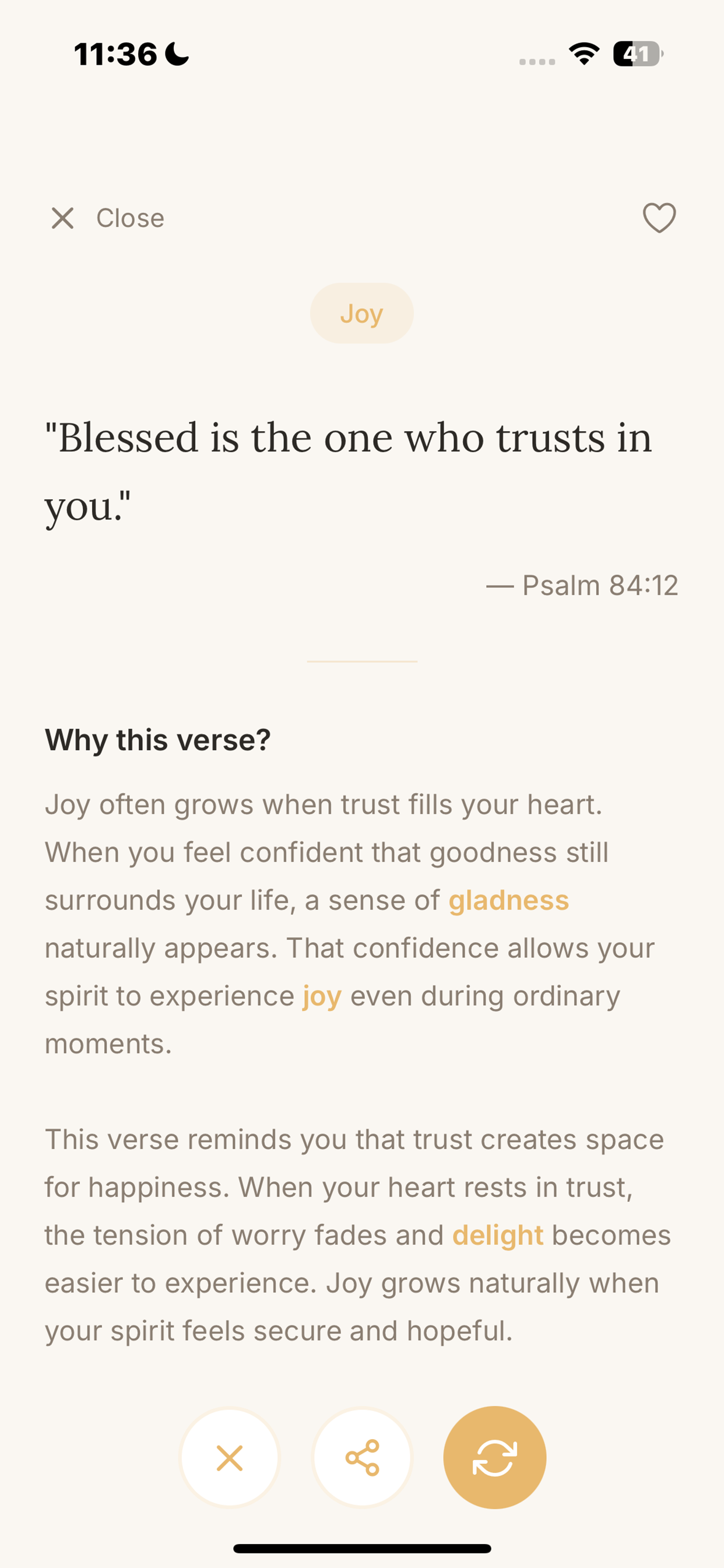
Open Faith Jar - free on the App Store
Tap what you’re feeling right now - ashamed, anxious, stuck, or weary - and receive a verse that helps steady your heart.
Renew your mind, stop rehearsing the past, and choose next-step obedience
After confession, the enemy loves replay. But healing often looks like refusing to rehearse yesterday’s failure all day long and instead taking today’s faithful step.
“Brothers and sisters, I do not consider myself yet to have taken hold of it. But one thing I do: Forgetting what is behind and straining toward what is ahead,” - Philippians 3:13 (NIV)
“It is for freedom that Christ has set us free. Stand firm, then, and do not let yourselves be burdened again by a yoke of slavery.” - Galatians 5:1 (NIV)
“Because of the Lord’s great love we are not consumed, for his compassions never fail. They are new every morning.” - Lamentations 3:22-23 (NIV)
If you need more help releasing what is behind, this companion guide on forgive and forget Bible verse can help you keep turning your mind toward grace instead of accusation.
Bible examples of people God restored after failure
Sometimes the heart needs more than an instruction; it needs a story. Peter, Paul, and David remind us that God does not only forgive in theory - He meets real people in real regret and leads them forward with mercy.
Peter after denial in John 21:15-19
Peter’s failure was public, painful, and deeply personal. Yet after Peter denied knowing Jesus, the risen Christ did not discard him; He asked Peter about love and then entrusted him with care for His people.
“The third time he said to him, ‘Simon son of John, do you love me?’ Peter was hurt because Jesus asked him the third time, ‘Do you love me?’ He said, ‘Lord, you know all things; you know that I love you.’ Jesus said, ‘Feed my sheep.’” - John 21:17 (NIV)
For the woman who keeps replaying what she said, what she avoided, or how she failed under pressure, Peter’s story is tenderly hopeful. Jesus knew the whole truth - and still called Peter forward.
Paul after persecuting the church in 1 Timothy 1:15-17 and Romans 7-8
Paul did not minimize his past. He named it honestly, but he also let God’s mercy become the loudest word over his life. His story shows that serious failure does not place someone beyond the reach of Christ’s patience.
“Here is a trustworthy saying that deserves full acceptance: Christ Jesus came into the world to save sinners - of whom I am the worst.” - 1 Timothy 1:15 (NIV)
“But for that very reason I was shown mercy so that in me, the worst of sinners, Christ Jesus might display his immense patience as an example for those who would believe in him and receive eternal life.” - 1 Timothy 1:16 (NIV)
Paul also understood the ongoing struggle with sin and the ache of wanting to be different. His hope was not self-punishment, but freedom in Christ.
“because through Christ Jesus the law of the Spirit who gives life has set you free from the law of sin and death.” - Romans 8:2 (NIV)
David after confession in Psalm 51 and Psalm 32
David’s repentance was not polished or defensive. He came before God with a broken, honest heart, trusting that confession would be met by mercy.
“Surely I was sinful at birth, sinful from the time my mother conceived me.” - Psalm 51:5 (NIV)
“Then I acknowledged my sin to you and did not cover up my iniquity. I said, ‘I will confess my transgressions to the Lord.’ And you forgave the guilt of my sin.” - Psalm 32:5 (NIV)
David’s story is a gentle reminder: you do not have to hide from God until you feel clean enough. You come to Him because He is the One who forgives, restores, and steadies your heart again.
Verses for specific emotions tied to self-forgiveness
Sometimes the hardest part is not knowing which truth to hold onto when your heart is spiraling. Different feelings need different reminders, and Scripture meets us gently in each one.
For shame and self-condemnation
Shame says your worst moment is your truest name. But God speaks more tenderly and more truthfully than your inner accuser ever will. When you feel stained, unworthy, or embarrassed by what you’ve done, verses like Romans 3:23–24 remind you that sin is universal, but so is the offer of grace in Christ.
Jude 1:24 is especially comforting for women who feel spiritually exhausted by their own mistakes: God is able to keep you and present you without shame before Him. Ephesians 1:13–14 can also steady you when guilt starts rewriting your identity, because it points you back to the security you have in the Holy Spirit, not in your flawless record. If guilt has started to sound like “I am beyond love,” it may also help to spend time with /bible-verses-about-self-worth/.
For anxiety, overthinking, and replaying the moment
Some regrets grow loudest at night, in the quiet, when your mind replays every word, tone, and choice. In those moments, Scripture can interrupt the loop. Philippians 4:8 is a gentle guide for redirecting your thoughts, and 2 Corinthians 1:3–4 reminds you that God meets you as the Father of compassion, not as a cold observer of your struggle.
If you are carrying consequences, James 1:5 is a beautiful place to turn: ask God for wisdom for the next step instead of spending all your strength reliving the last one. And if bedtime is when shame tends to rise, /bible-verse-before-sleeping-at-night/ may help quiet your heart.
For starting again after a painful mistake
Starting again can feel fragile. You may still grieve what happened, yet God is not finished writing your story. Jeremiah 29:11 offers hope that your future is not canceled, and Romans 8:28–30 reminds you that God is able to work even painful things into His redeeming purposes.
This does not erase consequences or pretend the hurt was small. It means mercy still has somewhere to lead you. When you need courage to begin again, it may help to linger with verses about new beginnings.
What Matthew 6:14 and Colossians 3:13 mean about forgiveness
These verses can feel tender if you are already carrying regret. Read gently: Jesus is not handing you one more weapon to use against yourself, but showing what grace does in a softened heart.
Explain Matthew 6:14-15 in the context of forgiving others
In Matthew 6, Jesus is speaking plainly about forgiving other people. The focus is not self-forgiveness as a phrase, but the serious, heart-level connection between receiving mercy from God and refusing mercy to others.
“For if you forgive other people when they sin against you, your heavenly Father will also forgive you. But if you do not forgive others their sins, your Father will not forgive your sins.” - Matthew 6:14-15 (NIV)
This is sobering, but it is not meant to shove a repentant woman deeper into shame. It reminds us that forgiven people are being reshaped by forgiveness. Jesus makes a similar point in the parable of the unmerciful servant:
“Shouldn’t you have had mercy on your fellow servant just as I had on you?” - Matthew 18:33 (NIV)
Explain Colossians 3:13 as a model of grace received and extended
Colossians 3:13 gives a beautiful pattern: grace is first received, then extended. We do not forgive from emptiness or from moral superiority. We forgive because the Lord has already met us with mercy we did not earn.
“Bear with each other and forgive one another if any of you has a grievance against someone. Forgive as the Lord forgave you.” - Colossians 3:13 (NIV)
Paul says the same with warmth and kindness in Ephesians:
“Be kind and compassionate to one another, forgiving each other, just as in Christ God forgave you.” - Ephesians 4:32 (NIV)
If your heart is stuck in harshness toward yourself or someone else, these verses invite you back to the same source: Christ’s forgiveness.
Tie both back to the reader’s struggle without forcing a harsh interpretation
So what does this mean when you are trying to forgive yourself? It means Scripture’s language is usually about receiving God’s forgiveness so deeply that you stop clutching forgiven sin like it still defines you. These verses do not command, “Absolve yourself apart from God.” They call you to live as someone who has truly been shown mercy.
If shame has turned into believing you are beyond love, it may help to remember who you are now:
“Yet to all who did receive him, to those who believed in his name, he gave the right to become children of God.” - John 1:12 (NIV)
And if regret has started to distort your worth, you may also find comfort in these bible verses about self worth.
A short prayer and declaration for forgiving yourself
Sometimes the hardest part is not knowing God forgives, but letting that truth reach the places where shame still whispers. If private guilt has made you quiet, tired, or spiritually numb, these words can help you come back into the light gently.
Prayer for women carrying private guilt
If you do not know what to say, keep your prayer honest and simple. You do not need polished words - just a willing heart that brings regret into God’s mercy and asks Him to steady you again.
“If our hearts condemn us, we know that God is greater than our hearts, and he knows everything.” - 1 John 3:20 (NIV)
“Come now, let us settle the matter,” says the Lord. “Though your sins are like scarlet, they shall be as white as snow; though they are red as crimson, they shall be like wool.” - Isaiah 1:18 (NIV)
A short prayer: Lord, You see the thing I keep replaying and the guilt I carry in silence. Thank You that You are greater than my condemning heart. Wash what feels stained, quiet what feels restless, and teach me to receive the mercy You freely give. Help me walk in truth, humility, and peace. Amen.
Simple declarations based on Scripture, not self-help slogans
When shame rises, it helps to answer it with God’s words instead of your feelings alone. These are not phrases to hype yourself up; they are quiet reminders of what is true in Christ.
“For he has rescued us from the dominion of darkness and brought us into the kingdom of the Son he loves, in whom we have redemption, the forgiveness of sins.” - Colossians 1:13-14 (NIV)
“Because of the Lord’s great love we are not consumed, for his compassions never fail.” - Lamentations 3:22 (NIV)
You might pray them like this: In Christ, I am not trapped in darkness. In Christ, forgiveness is real. Because of the Lord’s love, I am not consumed by this failure. His compassion has not run out this morning.
Encouragement to return to these verses when shame resurfaces
Shame often comes back in waves - late at night, after a hard conversation, or when a memory catches you off guard. That does not mean God has changed His mind about you; it means you may need to return to His truth again and again, tenderly and on purpose. If nighttime regret is especially hard, a gentle next step is to keep a few calming Scriptures nearby, like these Bible verses before sleeping at night.
“The Lord your God is with you, the Mighty Warrior who saves. He will take great delight in you; in his love he will no longer rebuke you, but will rejoice over you with singing.” - Zephaniah 3:17 (NIV)
“To him who is able to keep you from stumbling and to present you before his glorious presence without fault and with great joy - ” - Jude 1:24 (NIV)
Come back to these verses as many times as needed. Receiving grace is not denial; it is learning to agree with God more than with your shame.
Frequently Asked Questions
What does God say about self-forgiveness?
The Bible does not directly give the command, “forgive yourself,” but it does speak very clearly about confessing sin, turning back to God, and receiving His mercy fully. If you are in Christ, “there is now no condemnation for those who are in Christ Jesus” (Romans 8:1, NIV). First John 1:9 says that when we confess, He is “faithful and just and will forgive us our sins and purify us from all unrighteousness.”
That means your hope is not in excusing yourself, but in agreeing with God about your sin and then agreeing with Him about His grace. He says, “I will forgive their wickedness and will remember their sins no more” (Hebrews 8:12), and “as far as the east is from the west, so far has he removed our transgressions from us” (Psalm 103:12). Receiving that mercy is often what people mean when they talk about self-forgiveness.
What does Matthew 6:14 say?
Matthew 6:14 says, “For if you forgive other people when they sin against you, your heavenly Father will also forgive you” (NIV). In context, Jesus is teaching about forgiving others, not directly about forgiving yourself. He is showing that hearts changed by God’s mercy become hearts that extend mercy.
This connects to your own struggle gently but meaningfully. When you truly receive God’s forgiveness, it reshapes how you hold sin - both other people’s and your own. It does not mean pretending wrong did not matter. It means grace is becoming stronger than bitterness, and mercy is becoming stronger than self-punishment.
How to ask God to help you forgive yourself?
Start simply and honestly. Name the specific sin or regret before God instead of speaking in vague generalities. First John 1:9 reminds you that confession is safe with Him, and Hebrews 4:16 invites you to “approach God’s throne of grace with confidence” so you may receive mercy and find grace to help in your time of need.
You can pray something like: “Lord, I confess what I did. Thank You that Jesus has already paid for my sin. Please renew my mind, quiet my accusing thoughts, and teach me to dwell on what is true” (see Philippians 4:8). You do not have to force peace into your heart all at once. Just keep bringing the same wound into the light until His truth feels more real than your shame.
What does Colossians 3:13 say about forgiveness?
Colossians 3:13 says, “Bear with each other and forgive one another if any of you has a grievance against someone. Forgive as the Lord forgave you” (NIV). The main point is clear: the way we forgive others is shaped by the way God has forgiven us.
That truth also speaks tenderly to self-condemnation. If the Lord has forgiven you, it is not humility to keep holding your forgiven sin over your own head forever. Colossians 3:13 does not call you to deny what happened, but it does invite you to live like grace is real - received from God, then extended outward, and no longer resisted inwardly.
Is forgiving yourself biblical?
In a careful sense, Scripture’s strongest language is not “forgive yourself,” but receive God’s forgiveness, walk in repentance, and stop living under condemnation. The danger is trying to absolve yourself apart from God, as if peace could come from your own verdict. Real freedom comes through Christ, not self-approval.
So if by “forgiving yourself” you mean releasing ongoing self-condemnation after honest confession and repentance, that fits the heart of biblical grace. God calls you to bring your sin into the light, receive what Jesus finished at the cross, and walk forward as someone truly cleansed and loved.
Why do I still feel guilty after God forgave me?
Sometimes guilt lingers because the consequences are still painful, the memory is still tender, or your mind keeps replaying the moment. Sometimes it is shame, not conviction - the feeling that what you did has become who you are. But Romans 8:1 says there is no condemnation for those who are in Christ Jesus. Colossians 2:13–14 says God forgave us all our sins and canceled the charge against us, nailing it to the cross.
A guilty conscience may also need time to be retrained by truth. Hebrews 10:22 speaks of hearts “sprinkled to cleanse us from a guilty conscience” (NIV). Keep praying, keep confessing what is truly yours, and keep refusing burdens God has already lifted. Lingering feelings do not mean God’s forgiveness failed. They often mean your heart is still learning to rest.
Can God still use me after a serious mistake?
Yes - beautifully, humbly, and often more tenderly than before. Peter denied Jesus, yet Jesus restored him in John 21:15–19. Paul had persecuted the church, yet he said, “Christ Jesus came into the world to save sinners - of whom I am the worst,” and still became a living example of mercy (1 Timothy 1:15–16, NIV). David sinned deeply, confessed deeply, and was not abandoned by God.
Your failure may change you, and it may leave real consequences behind, but it does not have to be the end of your story with God. He often restores people into a wiser, gentler faith. The next step may not be dramatic - it may simply be repentance, humility, and quiet obedience. But yes, God still uses people He has forgiven.
What is the difference between conviction and condemnation?
Conviction is the Holy Spirit lovingly telling the truth about sin so you will come back to God. It is specific, honest, and hopeful. It leads to confession, cleansing, and freedom. Psalm 32:5 shows this beautifully: “Then I acknowledged my sin to you... and you forgave the guilt of my sin” (NIV). Jesus also said, “Then you will know the truth, and the truth will set you free” (John 8:32).
Condemnation feels different. It is heavy, vague, and hopeless. It says, “You are ruined. Hide. Stay ashamed.” But Romans 8:1 says that in Christ, condemnation is no longer your portion. Conviction draws you toward God’s mercy; condemnation tries to drive you away from it. One leads to repentance and peace. The other traps you in fear and hiding.
Faith Jar
Find a verse for the moment you're actually in
Tap a feeling, save the scripture that meets you there, and come back to it when you need words for yourself or someone you love.