Trust in the Lord Verse: Proverbs 3:5-6 Meaning

Maybe you’re staring at a decision you can’t untangle, lying awake with your mind racing, or trying to hold it together while the future feels foggy. If you came looking for the trust in the Lord verse because you need something steady to hold onto today, this page is for you.
Here you’ll find the trust in the Lord verse in Proverbs 3:5-6, a gentle explanation of what each phrase means, and related scriptures for anxiety, guidance, peace, and hard seasons. It’s arranged to meet you right where you are, when your heart feels overwhelmed, and lead you softly into the hope this passage offers.
Quick answer
Best Bible verses about trusting the Lord
Best overall
“Trust in the Lord with all your heart and lean not on your own understanding; in all your ways submit to him, and he will make your paths straight.”
When afraid
“When I am afraid, I put my trust in you.”
Need guidance
“Show me the way I should go, for to you I entrust my life.”
Anxious thoughts
“You will keep in perfect peace those whose minds are steadfast, because they trust in you.”
Future uncertain
“In their hearts humans plan their course, but the Lord establishes their steps.”
Hard seasons
“The Lord is good, a refuge in times of trouble. He cares for those who trust in him.”
On this page
- The trust in the Lord verse: Proverbs 3:5-6
- What does ‘trust in the Lord with all your heart’ mean?
- What does ‘lean not on your own understanding’ mean?
- What does ‘in all your ways acknowledge him’ mean?
- What does ‘he will make your paths straight’ promise?
- Related Bible verses about trusting God when you feel anxious
- Related Bible verses about trusting God for guidance and direction
- Related Bible verses about God’s trustworthiness
- How to pray Proverbs 3:5-6 in hard seasons
- How to use this verse in daily life
The trust in the Lord verse: Proverbs 3:5-6
Some verses meet us like a deep breath, especially when life feels uncertain, heavy, or emotionally loud. Proverbs 3:5-6 is one of those beloved places in scripture - a steady word for women carrying decisions, worries, and unanswered questions.
Quote Proverbs 3:5-6 in the recommended translation
If you searched for the trust in the Lord verse, this is the passage you’re looking for in the NIV:
“Trust in the Lord with all your heart and lean not on your own understanding; in all your ways submit to him, and he will make your paths straight.” - Proverbs 3:5-6 (NIV)
These words are simple enough to remember and deep enough to hold onto in every season. They speak to the heart that wants direction, peace, and something stronger than its own shifting feelings.
Briefly explain why this is the anchor verse for trust
Proverbs 3:5-6 is the anchor verse for trust because it says so clearly what trust looks like: not just believing God exists, but resting your whole heart on Him instead of on your own limited view. It gently names both sides of the struggle - trusting God and resisting the urge to control everything yourself.
That is why this passage has comforted so many believers through anxious seasons, motherhood stress, relationship uncertainty, and moments when the next step is not obvious. It doesn’t ask you to know everything. It asks you to know where to place your heart.
If you want to keep exploring this theme more broadly, you may also find help in bible verses about trusting god.
Address the parent topic search for Proverbs 3:5-6 directly
For readers searching specifically for Proverbs 3:5-6, the meaning is this: trust God fully, do not make your own understanding your final authority, bring every part of your life to Him, and believe that He will guide you. This is not a promise of an easy life, but a promise of faithful direction.
A closely related proverb helps make that even clearer:
“In their hearts humans plan their course, but the Lord establishes their steps.” - Proverbs 16:9 (NIV)
So if Proverbs 3:5-6 is on your heart today, receive it as both invitation and reassurance. God is not asking you to carry tomorrow alone - He is asking you to trust Him with today.
What does ‘trust in the Lord with all your heart’ mean?
Trust can sound simple until life feels uncertain, heavy, or out of your hands. In real days of overthinking, caregiving, disappointment, and waiting, this phrase invites your heart to rest its full weight on God instead of trying to carry everything alone.
Biblical meaning of trust versus control
Biblical trust is not pretending everything is fine. It is releasing the need to manage every outcome and choosing God as your safer place when fear tells you to grip tighter.
“When I am afraid, I put my trust in you.” - Psalm 56:3 (NIV)
“Some trust in chariots and some in horses, but we trust in the name of the Lord our God.” - Psalm 20:7 (NIV)
“It is better to take refuge in the Lord than to trust in humans.” - Psalm 118:8 (NIV)
Control says, “I have to hold this together myself.” Trust says, “Lord, I bring You what I cannot hold.” If you want to keep following this theme more broadly, our Bible verses about trusting God page gathers scriptures for those exact moments.
What ‘with all your heart’ asks of a believer
“With all your heart” means trust is not meant to stay on the surface. God is asking for more than polite belief on Sunday morning; He invites your real fears, your private questions, your weary emotions, and your hopes for the future.
“Trust in him at all times, you people; pour out your hearts to him, for God is our refuge.” - Psalm 62:8 (NIV)
“Those who know your name trust in you, for you, Lord, have never forsaken those who seek you.” - Psalm 9:10 (NIV)
This kind of trust is wholehearted because it is relational. You are not handing your heart to an idea, but to the God who does not forsake you.
Why trust is deeper than positive thinking
Trust is deeper than optimism because it is rooted in who God is, not in how bright today looks. Positive thinking depends on circumstances improving; trust holds on even when the path is dim and your feelings have not caught up yet.
“You will keep in perfect peace those whose minds are steadfast, because they trust in you.” - Isaiah 26:3 (NIV)
“Yet I will rejoice in the Lord, I will be joyful in God my Savior.” - Isaiah 12:2 (NIV)
“Let not your hearts be troubled. You believe in God; believe also in me.” - John 14:1 (NIV)
That is why trust brings peace: not because you finally figured everything out, but because your heart has turned toward Someone faithful.
What does ‘lean not on your own understanding’ mean?
There are seasons when your thoughts feel loud, your options feel limited, and your heart wants certainty right now. This phrase gently reminds us that our view is real, but it is not complete - and God sees farther than we do.
The limits of human perspective in painful seasons
In painful or confusing seasons, we often can only see the next worry, the next conversation, or the next outcome we fear. Scripture does not shame that weakness; it simply invites us to remember that God’s wisdom reaches beyond what we can piece together in the moment.
“Trust in the Lord with all your heart and lean not on your own understanding.” - Proverbs 3:5 (NIV)
“For we live by faith, not by sight.” - 2 Corinthians 5:7 (NIV)
“Now faith is confidence in what we hope for and assurance about what we do not see.” - Hebrews 11:1 (NIV)
Leaning on your own understanding does not mean using wisdom or making plans is wrong. It means your own perspective cannot be the final place your heart rests.
How overthinking, fear, and self-reliance distort decisions
When fear takes over, our thoughts can start sounding wise simply because they are urgent. Overthinking can make every path seem dangerous, and self-reliance can make you feel as if everything depends on getting it exactly right.
“Anxiety weighs down the heart, but a kind word cheers it up.” - Proverbs 12:25 (NIV)
“Commit to the Lord whatever you do, and he will establish your plans.” - Proverbs 16:3 (NIV)
“Fear of man will prove to be a snare, but whoever trusts in the Lord is kept safe.” - Proverbs 29:25 (NIV)
Sometimes what feels like clarity is really pressure. That is why it helps to pause, pray, and let God steady your thoughts before you decide. If this struggle feels familiar, you may also find comfort in these scripture for when life feels out of control for uncertain outcomes.
Comforting examples of surrendering what you cannot see
Surrender is not pretending you understand everything. It is choosing to trust God with the pieces you cannot yet explain - especially when the road ahead is still dim.
“Who among you fears the Lord and obeys the word of his servant? Let the one who walks in the dark, who has no light, trust in the name of the Lord and rely on their God.” - Isaiah 50:10 (NIV)
“The Lord is my shepherd, I lack nothing. He makes me lie down in green pastures, he leads me beside quiet waters, he refreshes my soul… Even though I walk through the darkest valley, I will fear no evil, for you are with me.” - Psalm 23:1-4 (NIV)
“So do not fear, for I am with you; do not be dismayed, for I am your God. I will strengthen you and help you; I will uphold you with my righteous right hand.” - Isaiah 41:10 (NIV)
This is what surrender can look like in real life: taking the next faithful step, letting God be present in the unanswered parts, and trusting that His care is steadier than your ability to figure everything out.
What does ‘in all your ways acknowledge him’ mean?
This part of Proverbs 3:5-6 brings trust out of theory and into daily life. It means God is not only for crises and big crossroads, but for ordinary choices, quiet burdens, and the parts of your day no one else sees.
How to involve God in everyday decisions
To acknowledge God is to bring Him into your plans, reactions, priorities, and timing. It looks like pausing before you answer the text, accept the opportunity, make the purchase, or rush ahead with what seems obvious.
“In all your ways submit to him, and he will make your paths straight.” - Proverbs 3:6 (NIV)
“Show me the way I should go, for to you I entrust my life.” - Psalm 143:8 (NIV)
This is not complicated spirituality. It is a soft, steady habit of saying, “Lord, lead me here too.” If you want to keep exploring that posture, these Bible verses about trusting God gather more scriptures for real-life dependence.
Acknowledging God in relationships, work, motherhood, and waiting
Many women carry invisible decisions all day long - how to respond gently, how to stretch energy, how to keep showing up in a season that feels unclear. Acknowledging God means inviting Him into all of it: the hard conversation, the unfinished to-do list, the child who needs you again, the prayer that still feels unanswered.
“Trust in the Lord and do good; dwell in the land and enjoy safe pasture.” - Psalm 37:3 (NIV)
“But seek first his kingdom and his righteousness, and all these things will be given to you as well.” - Matthew 6:33 (NIV)
Seeking God first does not always remove the weight of responsibility, but it reorders the heart inside it. Instead of being ruled by urgency, you begin to ask, “What would faithfulness look like here, today?”
Prayerful dependence instead of spiritual performance
Acknowledging God does not mean trying to appear strong, polished, or spiritually impressive. It means honest reliance - bringing Him your need, your limits, and your lack of clarity, and trusting that He welcomes you there.
“Call to me and I will answer you and tell you great and unsearchable things you do not know.” - Jeremiah 33:3 (NIV)
“Do not be anxious about anything, but in every situation, by prayer and petition, with thanksgiving, present your requests to God.” - Philippians 4:6 (NIV)
God is not asking for flawless performance. He is inviting you into relationship - where prayer becomes the way you acknowledge Him, and dependence becomes the way you walk.
What does ‘he will make your paths straight’ promise?
When you are trying to make a decision, carry a family, or simply get through an uncertain week, this promise feels deeply personal. It speaks to the quiet ache of wanting to know that God will not leave you wandering without help.
What the verse does promise: guidance, direction, steadiness
“He will make your paths straight” points to God’s faithful direction, not random chance. It means He knows how to lead you in a way that is clear, steady, and right, even when your emotions are noisy. Psalm 16:11 echoes this tenderly by reminding us that God shows the path of life, and Psalm 21:7 adds the picture of a heart made secure through trust.
For many women, this promise matters most in ordinary decisions as much as major crossroads: a hard conversation, a waiting season, a work change, a parenting burden. God’s straight path often looks like quiet clarity, daily wisdom, and enough light for the next faithful step.
What it does not promise: an easy or pain-free life
A straight path is not the same as a painless one. Scripture never says that trusting God removes grief, disappointment, or the strain of unanswered questions. In fact, Romans 8:28 comforts us not by denying hardship, but by assuring us that God is still working within it. Psalm 112:7 also gives a realistic picture: bad news may still come, yet the heart can remain steadfast.
That matters, because sometimes we assume confusion means God has abandoned us. But often His faithfulness is seen not in the absence of trouble, but in His steadying presence through it. If you are in a hard season, you may also find comfort in God is in control scripture.
How God leads step by step rather than all at once
Usually, God does not hand us the full map. He leads in a way that teaches dependence, trust, and nearness. Matthew 6:33-34 gently turns our attention from tomorrow’s fears to today’s obedience, and Lamentations 3:22-23 reminds us that His mercies arrive fresh each morning.
So if you cannot see the whole outcome, that does not mean you are off course. Very often, a straight path is discovered one prayer, one choice, and one surrendered day at a time.
Related Bible verses about trusting God when you feel anxious
Anxiety often makes everything feel urgent, foggy, and heavier than it is. In those moments, God’s Word does not shame your trembling heart - it gently redirects it, one steadying truth at a time.
Verses for fear of the future
When your mind keeps running ahead to what might happen, trust grows by returning to what is true right now: God is already in tomorrow. Matthew 6:33-34 is especially tender here, because Jesus turns our attention away from future panic and back to daily dependence. Jeremiah 29:11 can also comfort a worried heart, not as a promise that everything will feel easy, but as reassurance that God’s purposes are not careless or cruel.
If your fear is tied to uncertainty, it can also help to spend time with Romans 8:28 and Hebrews 13:5-6. These verses remind you that even when the outcome is hidden, you are not abandoned in it.
Verses for peace when your mind is racing
Sometimes anxiety is less about one problem and more about the sheer noise inside your thoughts. In those moments, Philippians 4:6-7 and Isaiah 26:3 are beautiful places to return, because they speak directly to the connection between prayer, trust, and peace. Psalm 112:7 is also a quiet anchor for hard-news days, showing what a steadfast heart can look like when it is fixed on the Lord.
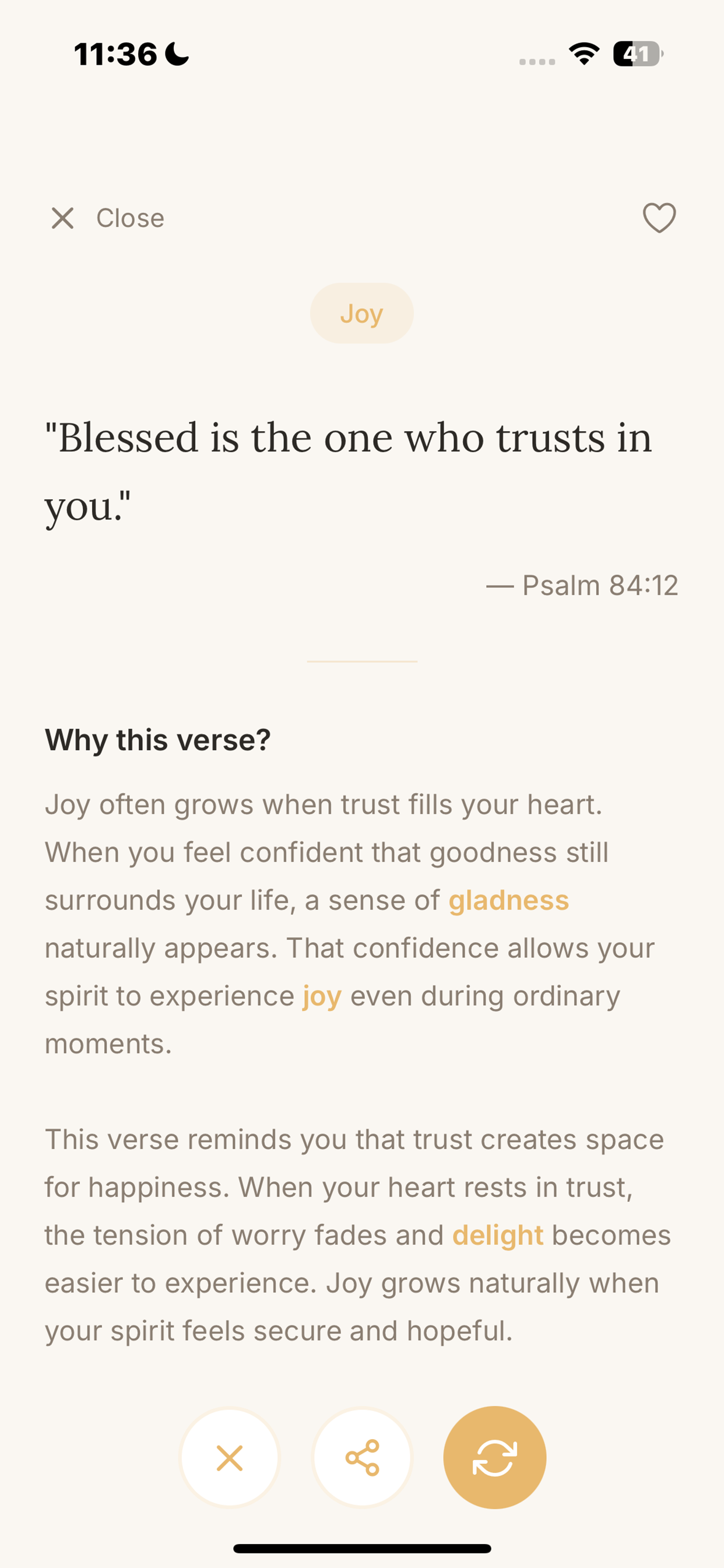
Sometimes scripture meets us best when we stop searching and just receive.
Open Faith Jar - free on the App Store
Tap how you feel right now and let a verse come to you.
If anxious thoughts tend to rise at night, it may also help to keep a few calming passages nearby from Bible verse before sleeping at night.
Verses for prayer, surrender, and refuge
When anxiety leaves you emotionally worn thin, the next faithful step may be simple prayer. First Peter 5:6-7 invites you to bring your cares to God because He cares for you, and Psalm 55:22 speaks to His sustaining help. For hearts that need safety more than explanation, Psalm 46:1 and Nahum 1:7 remind us that God is not distant in trouble - He is a refuge.
Related Bible verses about trusting God for guidance and direction
When you need direction, scripture often speaks in the language of paths, steps, and light for the road ahead. That is comforting, because God usually leads us one faithful step at a time, not by handing us the whole map at once.
Verses about paths, ways, and God’s leading
Some seasons feel like a crossroads, and others feel like walking through fog. In both, God’s Word reminds us that He is not absent from the path - you are being led even when the road is quiet.
“You make known to me the path of life; you will fill me with joy in your presence, with eternal pleasures at your right hand.” - Psalm 16:11 (NIV)
“Commit your way to the Lord; trust in him and he will do this.” - Psalm 37:5 (NIV)
“Surely, Lord, you bless the righteous; you surround them with your favor as with a shield.” - Psalm 5:12 (NIV)
Psalm 16 is especially tender for uncertain hearts: God does not merely point from far away; He makes known the path of life in His presence.
Verses about committing your plans to the Lord
Trusting God for guidance does not mean you never plan. It means your plans are held with open hands, shaped by prayer, and surrendered to the One who sees what you cannot. If you want to keep exploring this theme, Bible verses about trusting God gathers more scriptures for steadying your heart.
“In their hearts humans plan their course, but the Lord establishes their steps.” - Proverbs 16:9 (NIV)
“Trust in the Lord and do good; dwell in the land and enjoy safe pasture.” - Psalm 37:3 (NIV)
“Cast your cares on the Lord and he will sustain you; he will never let the righteous be shaken.” - Psalm 55:22 (NIV)
These verses gently shift us from pressure to dependence. We can make plans, but we do not have to carry the weight of making everything work.
Verses for times when you cannot see the outcome
There are moments when guidance is less about getting an answer immediately and more about staying close to God while you wait. When the outcome is unclear, His faithfulness becomes the place your heart rests.
“For I know the plans I have for you,” declares the Lord, “plans to prosper you and not to harm you, plans to give you hope and a future.” - Jeremiah 29:11 (NIV)
“The Lord is good, a refuge in times of trouble. He cares for those who trust in him.” - Nahum 1:7 (NIV)
“The Lord himself goes before you and will be with you; he will never leave you nor forsake you. Do not be afraid; do not be discouraged.” - Deuteronomy 31:8 (NIV)
When you cannot see the ending, these verses remind you that guidance is not only about information - it is also about God’s nearness, care, and steady presence.
Related Bible verses about God’s trustworthiness
Trust becomes steadier when it is anchored in who God is, not just in what we hope He will do. When your emotions feel changeable, Scripture keeps bringing you back to the unchanging heart of God.
God as refuge, rock, and shield
Some days you do not need a complicated explanation - you need a safe place for your heart to rest. That is why verses like Psalm 18:2, Psalm 46:1, and Psalm 91:2 are so comforting: they describe God as refuge, fortress, rock, and help in trouble.
These images matter because they remind you that God is not fragile, distracted, or distant. He is steady when life is not. If you are walking through uncertainty, relationship strain, or plain emotional exhaustion, these verses invite you to see Him as your protection rather than your last resort.
God’s faithful love and covenant care
God’s trustworthiness is also deeply personal. Deuteronomy 7:9 shows Him as the faithful God who keeps covenant, while Jeremiah 31:3 and Lamentations 3:22-23 remind us that His love is not temporary or moody - it is enduring, renewing, and merciful.
For many women carrying a quiet mental load, this matters more than we sometimes realize. Trust grows when you remember that God’s care is not based on your strength that day. His love stays consistent in ordinary mornings, sleepless nights, and long seasons of waiting. If you want to keep exploring that theme, scriptures on God’s faithfulness can be a gentle next step.
Why God’s character makes trust possible
At the deepest level, we trust God because He has proven Himself trustworthy. Psalm 13:5 points to His unfailing love, and Hebrews 13:5-6 reassures believers that His presence does not disappear when life gets hard. Trust is not pretending everything feels easy; it is choosing to rest in God’s character when you cannot yet see the outcome.
That is why biblical trust is so much more than optimism. It has substance. It says: God is faithful, God is near, and God will still be God in this moment too.
How to pray Proverbs 3:5-6 in hard seasons
Sometimes the most honest prayer is not polished at all - it is simply, “Lord, help me trust You here.” Proverbs 3:5-6 becomes especially tender in hard seasons because it gives you words when your mind is tired and your heart feels pulled in too many directions.
A short prayer for anxiety
When your thoughts are circling and your body feels tense, prayer does not have to be long. You can come to God in a few plain words and ask Him to steady what feels shaky inside. Psalm 112:7 and 1 Peter 5:6-7 both remind us that a heart can become firm again in God’s care.
Try praying like this: “Lord, my mind is busy and my heart feels unsettled. I choose to trust You more than my fears. Hold me close, quiet my thoughts, and help me rest in Your care today.”
A short prayer for a decision you cannot control
Some decisions feel heavy because even after you have prayed, thought carefully, and done what you can, the outcome is still not yours to manage. In those moments, trust looks less like certainty and more like releasing the need to see the whole path at once. Romans 8:28 and Psalm 21:7 can help anchor your heart when you are waiting.
You might pray: “Father, You see what I cannot see. I do not know how this will turn out, but I know You are faithful. Guide me in the next right step, and keep my heart steady while I wait.”
If you want more scripture for uncertain outcomes, you may also find comfort in god is in control scripture.
A short prayer for women carrying too much emotionally
There are seasons when the emotional weight is not one thing but everything at once - caregiving, work, relationships, disappointment, and quiet exhaustion. God meets you there with compassion, not pressure. Lamentations 3:22-23 and Hebrews 13:5-6 speak gently to the woman who feels worn thin.
Pray simply: “Lord, I have been carrying more than I can hold well. Be my strength where I feel weak, my peace where I feel frayed, and my refuge where I feel exposed. Teach me to trust You with all of this, not just the parts I know how to name.”
How to use this verse in daily life
Some verses are meant to be admired, and some are meant to be carried. Proverbs 3:5-6 becomes especially precious when it moves from a familiar line into an everyday rhythm you can return to in ordinary stress, quiet mornings, and hard interruptions.
Morning reflection or journaling prompt
Start the day by asking honestly, Where am I tempted to control today? Then place that specific concern before God - a conversation, a decision, your children, your body, your finances, your waiting. Trust grows when it becomes personal, not vague.
“In the morning, Lord, you hear my voice; in the morning I lay my requests before you and wait expectantly.” - Psalm 5:3 (NIV)
“Cause me to hear your lovingkindness in the morning, for in You do I trust; cause me to know the way in which I should walk, for I lift up my soul to You.” - Psalm 143:8 (NKJV)
A simple journaling prompt could be: Lord, here is what I am carrying today. Here is where I need to trust You more than my own understanding.
Memorization and repetition for stressful moments
Memorizing this verse gives your heart something steady to reach for when your thoughts start racing. Repeating God’s Word is not pretending everything is fine; it is gently pulling your mind back to what is true when fear wants the loudest voice.
“When anxiety was great within me, your consolation brought me joy.” - Psalm 94:19 (NIV)
“Surely the righteous will never be shaken; they will be remembered forever. They will have no fear of bad news; their hearts are steadfast, trusting in the Lord.” - Psalm 112:6-7 (NIV)
Try repeating one short phrase from Proverbs 3:5-6 in the moment you feel pressure rising: trust in the Lord, lean not, acknowledge him. Sometimes one line is enough to interrupt panic and reopen prayer.
When to return to this verse during the day
Come back to this verse when you receive difficult news, when you are overthinking a text message, when motherhood feels heavy, when work feels uncertain, or when the night makes everything feel bigger. Scripture often meets us best in the exact moment we notice our peace slipping.
“Cast your cares on the Lord and he will sustain you; he will never let the righteous be shaken.” - Psalm 55:22 (NIV)
“Trust in him at all times, you people; pour out your hearts to him, for God is our refuge.” - Psalm 62:8 (NIV)
If you need more support for that kind of daily surrender, you may also find comfort in these Bible verses about trusting God.
Frequently Asked Questions
What does Jeremiah 33:3 say?
Jeremiah 33:3 (NIV) says, “Call to me and I will answer you and tell you great and unsearchable things you do not know.” It is such a tender invitation from God: when you do not know what to do, you are not meant to carry that uncertainty alone.
This fits beautifully with Proverbs 3:5-6. Trusting in the Lord is not silent panic or pretending you are fine. It often looks like calling on Him for help, clarity, and comfort, then waiting with an open heart for His direction.
What is Proverbs 17:22 saying?
Proverbs 17:22 (NIV) says, “A cheerful heart is good medicine, but a crushed spirit dries up the bones.” In other words, what is happening in your heart affects your whole person. Joy brings life, while deep discouragement can leave you feeling drained and heavy.
This does not mean you have to force happiness. It means God cares about your inner life. As you trust Him in distress, He can steady your heart, lift a crushed spirit, and bring healing peace little by little.
What is Isaiah 26:3?
Isaiah 26:3 (NIV) says, “You will keep in perfect peace those whose minds are steadfast, because they trust in you.” This verse reminds us that peace is not found in having every answer. It grows as the mind keeps returning to God instead of spiraling into fear.
If anxiety has been loud lately, pair this verse with Philippians 4:6-7. As you bring your worries to God in prayer, His peace guards your heart and mind. Trust does not always remove the situation right away, but it does invite God’s calm into the middle of it.
What is psalm 28:7?
Psalm 28:7 (NIV) says, “The Lord is my strength and my shield; my heart trusts in him, and he helps me. My heart leaps for joy, and with my song I praise him.” There is a beautiful movement in this verse: trust leads to help, and help leads to praise.
If you feel emotionally worn down, this verse is a gentle place to rest. God does not shame weak hearts. He strengthens, protects, and helps the one who leans on Him, even before joy fully returns.
What does 'lean not on your own understanding' mean?
“Lean not on your own understanding” from Proverbs 3:5-6 does not mean wisdom, planning, or thoughtful decisions are wrong. It means your own perspective should not become your final authority. We see only part of the picture, but God sees the whole road ahead.
Proverbs 16:9 says, “In their hearts humans plan their course, but the Lord establishes their steps” (NIV). So yes, you can plan and think carefully. But trust means holding your plans with open hands and letting God guide, correct, or redirect you.
Does Proverbs 3:5-6 mean God will make life easy?
No, Proverbs 3:5-6 does not promise an easy or pain-free life. It promises God’s guidance, faithful leading, and a straight path in the sense of direction and steadiness. The road may still include grief, waiting, or hardship.
But you will not walk it alone. Psalm 23:4 says, “Even though I walk through the darkest valley, I will fear no evil, for you are with me” (NIV). And Isaiah 41:10 reminds us, “Do not fear... I will strengthen you and help you.” God’s promise is not ease, but His presence and care every step of the way.
How can I trust God when I feel anxious about the future?
Start small and honest. Tell God exactly what you are afraid of, then place that fear into His hands. Isaiah 26:3 points you to peace, Philippians 4:6-7 invites prayer instead of panic, Psalm 56:3 says, “When I am afraid, I put my trust in you” (NIV), and Matthew 6:33-34 reminds you to live one day at a time with the Father’s care.
One practical step is this: turn your fear into a short prayer. Something as simple as, “Lord, I am scared about tomorrow, but I trust You with what I cannot see.” When your heart is too overwhelmed to search for the right verse, open Faithjar, tap how you feel right now, and receive a Bible verse matched to your moment.
Faith Jar
Find a verse for the moment you're actually in
Tap a feeling, save the scripture that meets you there, and come back to it when you need words for yourself or someone you love.